Every headline today has read the same thing: "First diagnosed case of Ebola in the U.S." Yes, you read that right, that African disease that people have been talking about for a while has now jumped the Atlantic and landed in good ol' Dallas, Texas.
Of course the whole school started freaking out when the news broke, but no one freaked out quite as much as all the students who have taken or are currently taking microbiology here at TCU. Right now we are reading the Hot Zone, a book all about the original outbreaks of Ebola in Africa and the severity of the virus strand. We are just halfway through the book now and what we have learned about the disease scares us all to death. One day we're learning about a horribly deadly disease that is NOT in the U.S., and then the next day the Center for Disease Control is reporting that this disease is not only in the U.S., but its in the city just 45 minutes away from campus. A direct quote from one of my friends in my micro class: "That makes me want to cry". We have read hundreds of pages about what the virus can do, and how there is no foolproof cure or vaccine for it either. And now its here.
Ebola has been all over the news for a while now, but it wasn't until microbiology that I actually learned about what the disease does to the body and the long history of it. And now, everyone else wants to know what we have learned. At dinner I was answering questions about how Ebola is spread (fluid transmission), where the virus came from (Ebola river in Africa), and how it most likely first got to humans (through monkeys). I also had to explain that a person is only infectious once they have started exhibiting the symptoms (which the Dallas man was not while on his flight home, meaning it won't spread through the airplane).
I love when what you learn in class can be directly related to something going on around the world right now. The learning connection makes it all seem so much more real and allows you to see a purpose to what you are learning. In this case, Ebola is not a disease that has come and gone, it is still clearly a problem, and as a future healthcare professional, I am going to need to understand what the virus can do.
We've been asked to blog about our other learning experiences outside of Literature & Civilizations II, and the whole story of Ebola has definitely been a learning experience, from helping me with my studies in microbiology to simply educating me on what is happening in the global healthcare community. I've learned what the Center for Disease Control does to combat these viruses so they don't become and epidemic in the U.S. and how easily some diseases can be spread if not diagnosed and quarantined.
If you are at all interested in Ebola and curious what its history is, I highly recommend you pick up the Hot Zone by Richard Preston. It is a very interesting read that really helped me to understand what is happening in Africa and now the U.S. regarding disease outbreaks. Now don't worry y'all, yes Ebola is in Dallas, but the likelihood of it being spread is actually very low because the patient was quarantined very soon after exhibiting symptoms. That may or may not give you peace of mind, but hey at least we don't go to SMU.
Tuesday, September 30, 2014

Sunday, September 28, 2014
Home is where the drought is
Reading the Big Thirst and talking about both the current drought situation and water conservation has really hit home for me particularly. I am one of the many TCU students from California, where we're currently experiencing one of the worst megadroughts in history. Yes, it is a statewide drought, but what many people don't know is how hard it has hit northern California especially (my home). All of the pictures on the news are from lakes that I've been going to my whole life, and it is scary to know that they might not be there much longer. Northern California's many lakes supply most of central and southern california's water, but we don't have enough water for everyone anymore. They are draining our lakes just to keep the state's crops alive. Folsom Lake, a lake 10 minutes from my house that I grew up going to, is so dried up that you are not allowed to boat on it anymore. Two beaches we would go to in high school are now connected into one beach because the water level has gotten so low. Pictures of Folsom lake are constantly in news stories because it is in such drastic conditions. San Joaquin river that Dr. Williams showed us in class also right by my house.
Our governor declared a statewide drought emergency and we constantly are told to limit our water use to help conserve. The problem though is that no one (that I know of) is cracking down on the whole state like places like Las Vegas have done. But how could that even be done with such a big and opinionated state like California. Its not just a city with a water problem, its one of the biggest states in the country. If we don't get enough rain this year, it is scary to think of where we could be. The projections are frightening. This is my home that is more dry every time I visit. Actually experiencing the drought is so much different than just reading about it. It was hard for me to even grasp the severity of the whole situation until I saw one of lakes in person. My home is right smack in the middle of the "exceptional drought" area.
I was skeptical when I learned that this class would be about water, but it has actually been a very interesting topic considering our huge need for water and our dwindling resources. The first few chapters of the Big Thirst were fascinating because I previously didn't really consider ALL of the things that require clean water in our everyday life. The amount of water that we use on things like flushing toilets and watering lawns is astonishing. The talking of a "second modern water revolution" is a crazy thing to think about.
What I found very interesting while preparing for our presentation on the Big Thirst is the idea that all water problems are local. Conserving water in Texas is not going to help children in Africa get water, or even really help California. So even though the drought is slowly becoming nationwide, the solutions are local changes in individual communities and cities. If anything, reading the Big Thirst has made me, and hopefully others, acknowledge the current water crisis in a more realistic way.
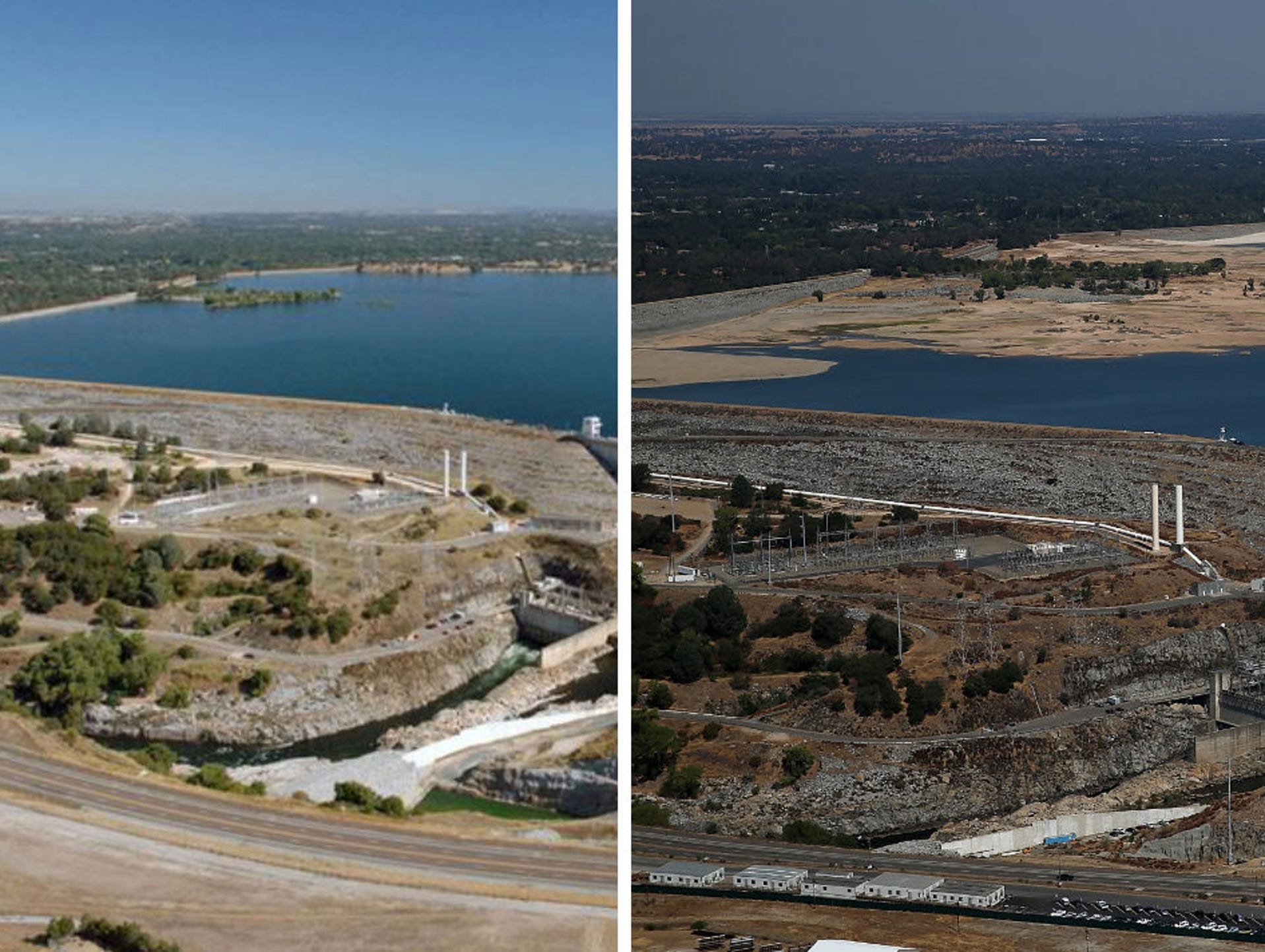 |
| Folsom Lake, California before and after |
Our governor declared a statewide drought emergency and we constantly are told to limit our water use to help conserve. The problem though is that no one (that I know of) is cracking down on the whole state like places like Las Vegas have done. But how could that even be done with such a big and opinionated state like California. Its not just a city with a water problem, its one of the biggest states in the country. If we don't get enough rain this year, it is scary to think of where we could be. The projections are frightening. This is my home that is more dry every time I visit. Actually experiencing the drought is so much different than just reading about it. It was hard for me to even grasp the severity of the whole situation until I saw one of lakes in person. My home is right smack in the middle of the "exceptional drought" area.
 |
| Current California drought monitor; Most of the state is now in exceptional drought |
I was skeptical when I learned that this class would be about water, but it has actually been a very interesting topic considering our huge need for water and our dwindling resources. The first few chapters of the Big Thirst were fascinating because I previously didn't really consider ALL of the things that require clean water in our everyday life. The amount of water that we use on things like flushing toilets and watering lawns is astonishing. The talking of a "second modern water revolution" is a crazy thing to think about.
What I found very interesting while preparing for our presentation on the Big Thirst is the idea that all water problems are local. Conserving water in Texas is not going to help children in Africa get water, or even really help California. So even though the drought is slowly becoming nationwide, the solutions are local changes in individual communities and cities. If anything, reading the Big Thirst has made me, and hopefully others, acknowledge the current water crisis in a more realistic way.
Monday, September 22, 2014
Traveling the Trinity
That Thursday marked the ending of one of the most stressful and emotional weeks of the semester so far. Right before the trip began I received hurtful news that did not put me in a good state of mind for a trip that I had previously been very excited for. I was running on too little sleep and too many emotions to appreciate the beginning of the 4.5 mile canoe trek. However, being stuck in a canoe with your best friend for a few hours can be surprisingly therapeutic to the soul. It was something that I never expected, but the canoe trip surprisingly helped to calm my mind and gave me time to relax for the first time in too long. At first I had been upset that the trip started off so rough for me, but then I became very thankful that it had coincided with certain life events. Floating along the Trinity River gave me time to appreciate the "little things" in life, as cliche as that sounds. The whole week I had been a ball of stress, worrying about both big and little things, and the canoeing allowed me to forget about it all for just a few hours. Together Casey and I figured out how to steer that canoe (it took awhile!) and that helped to distract me from the list of emotional things running through my mind. We laughed (at ourselves), complained (about too much to list), and ultimately made it down the river like a modern day Huck and Jim.

Halfway down the river I was already feeling better, yet none of my problems had been solved. They were still waiting for me back on land, but for those few hours all life issues were out of reach as we canoed in our own little world. I am a very logical and pragmatic person, someone who never would have thought that canoeing down a brown river would help me feel better after a long week, but it did. The journey calmed my previous anxiety and I believe helped me handle a stressful situation that was waiting for me back ashore. The serenity of the calm waters and the recurring motions of paddling was more therapeutic than I ever could have imagined. The entire setting was so tranquil and peaceful that even my racing mind could be calmed down for a few hours.
 Paddling up to that Fort Worth skyline at the end of the trip was a beautiful ending to a surprisingly valuable trip that ended up being exactly what I needed. The bright lights represented the real world where my problems sat
waiting for me to deal with, but the canoe and river aided me in
approaching them more wisely and calmly. Sure, when I got back to campus I still had to deal with my stressful problems, but the river trip had helped me to accept what had happened and had calmed my mind so that the problems seemed just a little bit more manageable.
Paddling up to that Fort Worth skyline at the end of the trip was a beautiful ending to a surprisingly valuable trip that ended up being exactly what I needed. The bright lights represented the real world where my problems sat
waiting for me to deal with, but the canoe and river aided me in
approaching them more wisely and calmly. Sure, when I got back to campus I still had to deal with my stressful problems, but the river trip had helped me to accept what had happened and had calmed my mind so that the problems seemed just a little bit more manageable.

Subscribe to:
Posts (Atom)