Janaina and I's last meeting of the semester was short and sweet. She was gearing up for her first Texan (and American) Christmas with her family, and I was counting down the days until my last final, so we met just briefly to chat.
This semester has gone by in a whirlwind, and our first conversation seems like just yesterday. We both have grown the last few months, Janaina in her English me in my appreciation for other cultures and languages. Never did I think I would ever have a chance to participate in something like this here at TCU. These "required" conversations have been a welcome break from my science labs.
We talked about school and my upcoming finals, as well as her family, an always popular topic of conversation for Janaina. Her kids are finishing up with school also, and excited to spend their first Christmas here, even though they still often miss Brazil. I cannot imagine picking up and moving to a whole other country and culture as a teenager. Growing up is hard enough, but doing so in a foreign place with a foreign language must be a crazy experience. Just moving from California to Texas was difficult for me.
While I hope to see Janaina again next semester, with our different lifestyles and busy schedules I am not certain it will be easy to do. Even if I do not get to sit down for coffee or lunch ever again with Janaina, I will always remember this experience. We participate in this program to gain global awareness credit, and while I already have this credit from studying abroad this summer, I still learned so much through this portion of the class. I learned to appreciate those who work to learn our language so much more, because it is not easy. I learned about Janaina's Brazilian culture and the differences between it and our American culture. Overall this semester in Literature and Civilization II has been a memorable one, largely because of the conversation partner program. If it were possible, I think all global awareness credit courses at TCU should do this.
This final conversation blog is also my last blog for this course, and I have thoroughly enjoyed every minute of it. Blogging has been a great way to write about what we're learning in and out of class, and it has been so fascinating to see what everyone has learned this semester. Merry Christmas everyone, and thanks for a great semester!
Tuesday, December 16, 2014

Monday, December 15, 2014
Coffee and Conversation
Last week I met with my conversation partner, Janaina, for coffee at union grounds. I was knee-deep in studying for finals, so it was nice to take a much-needed caffeine break and relax with her. We talked about how our weeks had been, and I found out she was in the middle of her finals. She seemed quite stressed about them, while I was stressed about the anticipation of my finals to come.
During this meeting, Janaina wanted to get to more about me, as usually we are talking about her and her Brazilian culture. We've talked about my home in California but not really about my life here in Texas. I talked about how I'm preparing to start my nursing clinicals next semester, and I explained what exactly that meant. She was just as excited as I was about getting to work in an actual hospital. Janaina remarked that she could tell I would do great just by seeing the happiness in my face when I talk about nursing, something that really warmed my heart to hear.
Janaina is much older than me, almost the same age as my mom, so our experience has been quite different from some of the other conversation partners, but what I have grown to love so much is how encouraging she is to me. She is the one studying an entire new language and culture, but always loves to hear about my own nursing studies and what my classes and labs are like. Her children are so lucky to have such a happy and strong mother.
With all the craziness surrounding football lately, I asked her if she went to any of the games this season. She hadn't, mostly because football is still a foreign idea to her. I explained how electric the stadium gets on game day and how well our football team did this year. TCU sports are so much fun to watch, so I encouraged her to take her kids to a horned frog basketball or baseball game this year. Just remember to wear purple!!
Our relaxed conversation was just the break I needed from all the craziness of preparing for finals, I am so glad I got to share some more time with Janaina (and that it came with more coffee).
During this meeting, Janaina wanted to get to more about me, as usually we are talking about her and her Brazilian culture. We've talked about my home in California but not really about my life here in Texas. I talked about how I'm preparing to start my nursing clinicals next semester, and I explained what exactly that meant. She was just as excited as I was about getting to work in an actual hospital. Janaina remarked that she could tell I would do great just by seeing the happiness in my face when I talk about nursing, something that really warmed my heart to hear.
Janaina is much older than me, almost the same age as my mom, so our experience has been quite different from some of the other conversation partners, but what I have grown to love so much is how encouraging she is to me. She is the one studying an entire new language and culture, but always loves to hear about my own nursing studies and what my classes and labs are like. Her children are so lucky to have such a happy and strong mother.
With all the craziness surrounding football lately, I asked her if she went to any of the games this season. She hadn't, mostly because football is still a foreign idea to her. I explained how electric the stadium gets on game day and how well our football team did this year. TCU sports are so much fun to watch, so I encouraged her to take her kids to a horned frog basketball or baseball game this year. Just remember to wear purple!!
Our relaxed conversation was just the break I needed from all the craziness of preparing for finals, I am so glad I got to share some more time with Janaina (and that it came with more coffee).
Sunday, December 7, 2014
Weather changes and Reflecting on the Trinity
I visited the Trinity River briefly before Thanksgiving break to explore and reflect. It was a beautiful, sunny day at the river, with perfect weather begging me to relax and bask in the sun. I walked along the river and eventually walked out on the rocks in the middle of the water. Standing on the large rocks in the middle of the quiet, simple beauty of the Trinity was extremely relaxing and surprisingly enjoyable. The sun was bright and shining on me as I let go of our stress for a few minutes to sit back and enjoy the little taste of nature. When I had to unfortunately leave to get back in time for class, I told myself that I should definitely come back soon
I returned to the Trinity in December ready to have the same experience that I had before. It was a completely different day however. The weather had begun to finally accept that it is winter and the clouds had covered the sun when I arrived. There was a slight wind and and outside was just an overall gloomier environment. I walked down to the rocks again and sat down on them at the center of the river. The weather change meant the rocks were no longer warm to the touch and as comfortable to lay down on. It was still peaceful to sit there, but in a different way. The cold air was invigorating and I left feeling refreshed and rejuvenated, but not quite as happy as I left the other day.
It was amazing how the weather change impacted my experiences on the Trinity. The different weather gave me completely different feelings while I sat by the river. The sunny day made me feel tranquil and put my mind at ease. The colder day rejuvenated my body and gave me energy to push through the next few weeks. In true Texas fashion the weather changed rapidly, and with it my experience with the Trinity River. I'm glad I chose to visit on these two different days, otherwise I would have only gotten one feeling reflecting on the river. I never really considered just how much weather can impact our experiences and change how we view a place and experience.
During my trips to the Trinity I had time to simply sit down, be quiet, and think. No distractions but the sound of water falling over the rocks. In college these kind of moments are few and far between. We are constantly with someone, talking about something, or on your way to the next class or meeting. Forcing myself to make time to go the river both of these days was more beneficial for my mind than I ever could have thought. As cliche as it sounds, reflecting on the Trinity gave me time to myself to sort through the many things currently on my mind. From lab finals to final presentations these last few and next few weeks are packed to the brim with things that somehow must all get finished. This time of year it is especially hard to make yourself stop and take a break from it all, and having to go the river gave me this break. Leaving campus just for an hour gave me a chance to back away from everything before jumping right back in with a clearer head.
During my trips to the Trinity I had time to simply sit down, be quiet, and think. No distractions but the sound of water falling over the rocks. In college these kind of moments are few and far between. We are constantly with someone, talking about something, or on your way to the next class or meeting. Forcing myself to make time to go the river both of these days was more beneficial for my mind than I ever could have thought. As cliche as it sounds, reflecting on the Trinity gave me time to myself to sort through the many things currently on my mind. From lab finals to final presentations these last few and next few weeks are packed to the brim with things that somehow must all get finished. This time of year it is especially hard to make yourself stop and take a break from it all, and having to go the river gave me this break. Leaving campus just for an hour gave me a chance to back away from everything before jumping right back in with a clearer head.
I am looking forward to more trips to the Trinity whenever I feel the need to get away and calm my mind down. As the semester winds down I will not forget the feeling the river gave me, and now I can match the weather to whatever I am looking to get out of the visit. Next May you might just find me back by the river trying my best to take a break from finals once again.


Saturday, December 6, 2014
Lunch with Janaina
Recently I met with my conversation partner Janaina again for lunch. It was so nice to catch up with her on how her semester has been. She spoke very excitedly about how much she was learning about the English language, and on how much more difficult it was to learn than she had expected. Raising a family and living outside of Fort Worth makes it often hard to find enough time to get all the work done. I am amazed at how much her control of the language has improved just over this semester. Her writing skills have also rapidly improved, which I have noticed from her emails. English is so difficult to learn and I applaud all of her work to conquer it.
At lunch we just talked about life and school. Janaina was very interested in both this class and my nursing classes and how the nursing school worked. She is always interested in my life at TCU and how my week has been going whenever we meet, and this time was no different. We talked about what I did for Thanksgiving and about my home in California. She remarked that she has never been to the west coast but its on her list of places to visit soon. I insisted that she has to go to San Francisco when she does go, because it is one of my favorite cities in the entire world. Listening to me talk about California Janaina asked why I decided to leave and if I ever will move back. Whether I will go back is the million dollar question with my family, and honestly I have no idea.
Janaina and her family will be staying in Texas for the holidays this year and it will be their first Christmas in America. She explained some of her favorite holiday traditions and shared some of mine. Some of them were actually pretty similar, although her family's holiday food sounds much more exciting! I can't wait to hear how their Texas Christmas goes and how it compares to their Christmases in Brazil.
Our conversations are unfortunately usually brief because of our extremely busy and differing schedules, but the little time that Janaina and I do get to have together are always thoroughly enjoyable. I look forward to many more to come.
At lunch we just talked about life and school. Janaina was very interested in both this class and my nursing classes and how the nursing school worked. She is always interested in my life at TCU and how my week has been going whenever we meet, and this time was no different. We talked about what I did for Thanksgiving and about my home in California. She remarked that she has never been to the west coast but its on her list of places to visit soon. I insisted that she has to go to San Francisco when she does go, because it is one of my favorite cities in the entire world. Listening to me talk about California Janaina asked why I decided to leave and if I ever will move back. Whether I will go back is the million dollar question with my family, and honestly I have no idea.
Janaina and her family will be staying in Texas for the holidays this year and it will be their first Christmas in America. She explained some of her favorite holiday traditions and shared some of mine. Some of them were actually pretty similar, although her family's holiday food sounds much more exciting! I can't wait to hear how their Texas Christmas goes and how it compares to their Christmases in Brazil.
Our conversations are unfortunately usually brief because of our extremely busy and differing schedules, but the little time that Janaina and I do get to have together are always thoroughly enjoyable. I look forward to many more to come.
Wednesday, December 3, 2014
Conversations with Janaina
Being able to meet with my conversation partner Janaina these last few months has been a very gratifying and unique experience. I've never before stopped to think about how the majority of the world chooses to learn English as their second language and how difficult the learning process can be. We are so lucky to have been raised in America and grow up speaking English. Traveling around Europe I have noticed that most people speak at least a little English or are trying to learn. Think about how different it is here in the US. Yes, we have mandatory foreign language classes that we took in high school and maybe college but if they weren't required would we actually pursue another language? We have accepted that the rest of the world will learn English and it is therefore not as important for us to learn their languages.
In our emerging global society, language still serves as a barrier to communication, business, and learning. The students in the IEP program here at TCU are studying to bridge this language gap, and it has motivated me to want to learn parts of their languages, as my major does not have a foreign language requirement. It is easy to become hyper-focused on our own world here in Texas, and talking with Janaina about her home and family in Brazil has given me a broader world view and allowed me to explore and learn about a place I have never been to.
Janaina has been so kind, opening up about her family and children and how they are adapting to American (and Texan) life. I can't even imagine moving to another country and barely knowing the native language. Her drive to learn English and learn about our culture is surprisingly motivating and has given me a new found appreciation for our unique American culture as well as her Brazilian culture.
The TCU mission statement is "to educate individuals to think and act as ethical leaders and responsible citizens in the global community", and this experience has emphasized this mission more than any of my other classes this semester. Talking with Janaina has taught me just how difficult learning English can be for immigrants and foreigners abroad, and I've learned how important it is to be patient throughout their English learning. The next time I am abroad I will have a new appreciation for every foreigner who has learned my native language and who has given us the ability to communicate. This has truly taught me what it means to be a responsible citizen in the global community, because it has taught me how to appreciate language as a barrier and a route to learning about new cultures and parts of the world.
In our emerging global society, language still serves as a barrier to communication, business, and learning. The students in the IEP program here at TCU are studying to bridge this language gap, and it has motivated me to want to learn parts of their languages, as my major does not have a foreign language requirement. It is easy to become hyper-focused on our own world here in Texas, and talking with Janaina about her home and family in Brazil has given me a broader world view and allowed me to explore and learn about a place I have never been to.
Janaina has been so kind, opening up about her family and children and how they are adapting to American (and Texan) life. I can't even imagine moving to another country and barely knowing the native language. Her drive to learn English and learn about our culture is surprisingly motivating and has given me a new found appreciation for our unique American culture as well as her Brazilian culture.
The TCU mission statement is "to educate individuals to think and act as ethical leaders and responsible citizens in the global community", and this experience has emphasized this mission more than any of my other classes this semester. Talking with Janaina has taught me just how difficult learning English can be for immigrants and foreigners abroad, and I've learned how important it is to be patient throughout their English learning. The next time I am abroad I will have a new appreciation for every foreigner who has learned my native language and who has given us the ability to communicate. This has truly taught me what it means to be a responsible citizen in the global community, because it has taught me how to appreciate language as a barrier and a route to learning about new cultures and parts of the world.
Monday, December 1, 2014
The Old Man and the Sea
The Old Man and the Sea has many themes and conflicts throughout, but one of the things that stood out to me was Santiago's relationship with the sea and sea life. The old man personifies the ocean with the ways he talks to and about it. Santiago refers to the ocean as a woman when he says that "she is kind and very beautiful". He thinks of the sea as "la mar", as that is how the Spanish who love it refer to it as. Calling the sea "la mar" leads the reader to picture the sea as a feminine, strong spirit. Throughout Santiago's journey on the ocean, he is constantly talking to the ocean in a way someone would speak to a respected friend. Santiago recognizes the ocean's power and influence in his life. Sailing his skiff through the sea is not something he takes lightly, and he sees that the ocean has a mind of its own.
The old man truly appreciates the sea and its inhabitants both as his family and as powerful forces of nature. Through his journey he allows himself to become one with the sea and accepts its good and bad attributes. Santiago truly loves the ocean and sees it as a part of his soul. While he has a loving relationship with his apprentice Manolin, his relationship with the sea is what caught my attention. When Santiago is all alone on his boat, he has nothing but the sea and the animals to keep him company, and so his connections with both become much deeper.
Santiago becomes extremely attached to the marlin over the many days at sea. At times he feels deep sorrow for killing him, and wonders if he really should be a fisherman. Santiago refers to all of the fish in the sea as his brothers. He also ponders whether anyone is truly worthy of eating this fish that he now refers to as his friend. The whole journey back the old man is talking to the marlin, at one point telling him that he will fight away the sharks so that this whole ordeal was not "for nothing".
The relationship Hemingway creates between man and water is similar to other things we have read this semester. The protagonists in The River Why and A River Runs Through It both saw the river in the same way that Santiago views the sea. This loving and respecting relationship with water is a common theme found in our readings and learning.
I really enjoyed reading this novel, perhaps because I felt that there was not as much hidden "underwater" as there was in some of Hemingway's other stories. The novella was slow and at first read not very exciting, but after diving deeper into it both on my own and in our class discussion I found myself more appreciative of its unique style.
The old man truly appreciates the sea and its inhabitants both as his family and as powerful forces of nature. Through his journey he allows himself to become one with the sea and accepts its good and bad attributes. Santiago truly loves the ocean and sees it as a part of his soul. While he has a loving relationship with his apprentice Manolin, his relationship with the sea is what caught my attention. When Santiago is all alone on his boat, he has nothing but the sea and the animals to keep him company, and so his connections with both become much deeper.
Santiago becomes extremely attached to the marlin over the many days at sea. At times he feels deep sorrow for killing him, and wonders if he really should be a fisherman. Santiago refers to all of the fish in the sea as his brothers. He also ponders whether anyone is truly worthy of eating this fish that he now refers to as his friend. The whole journey back the old man is talking to the marlin, at one point telling him that he will fight away the sharks so that this whole ordeal was not "for nothing".
The relationship Hemingway creates between man and water is similar to other things we have read this semester. The protagonists in The River Why and A River Runs Through It both saw the river in the same way that Santiago views the sea. This loving and respecting relationship with water is a common theme found in our readings and learning.
I really enjoyed reading this novel, perhaps because I felt that there was not as much hidden "underwater" as there was in some of Hemingway's other stories. The novella was slow and at first read not very exciting, but after diving deeper into it both on my own and in our class discussion I found myself more appreciative of its unique style.
Saturday, November 22, 2014
Fort Worth Water Gardens
Arguably the best part of this entire course has been the opportunities to go on field trips around Fort Worth to explore water in different ways. From canoeing on the trinity to touring the Amon G. Carter art museum, these hands on experiences have made me grow to truly love this class. One of our most recent trips to the Fort Worth Water Gardens was particularly interesting. I had never actually visited the gardens, and I had no idea that they were hidden right in the middle of downtown Fort Worth. I also had no idea what to expect, because what exactly is a "water garden"? Many definitions of water gardens describe them as gardens of aquatic plants, but that is not the case in Fort Worth. The water gardens we visited were focused primarily on the water, not on any aquatic wildlife.
One of my favorite water features was the active pool that has gallons of water cascading down large steps into a small pool. We were able to walk down into the middle of the pool and take in the rushing water. It was a complete visual and auditory experience, taking in the entire water feature from the center of it. The active pool used water's power and sensory beauty to create a breathtaking show.
Some chose to sit and observe the active pool for most of the time, but we chose to explore what the gardens had to offer. Just past the active pool was the aerating pool, a large pool indented into the ground with water spraying up creating an illuminating and refreshing experience. If you caught the right light, all of the different water sprays created a beautiful rainbow. The aerating pool was incredibly serene and peaceful, portraying the beauty of water in a different way than the active pool did. Some of the pictures we took of the aerating pool turned out simply breathtaking because of the way the water caught the late afternoon sunshine.
Our final stop on our exploration was climbing up the "mountain" to look over all the water gardens and even see outside to parts of the city. The mountain was obviously not a water feature, but climbing to the top did give us a birds eye view of some of the other features, once again offering just another perspective to looking at water.
The water gardens serve as an oasis in the middle of bustling city. Tall buildings loom over the gardens, yet the large oak trees provide enough cover to make you really feel transported somewhere else. The gardens are an extremely peaceful place to visit and make you stop and take in the beauty of water. These field trips are a great addition to this class, even if sometimes because they're just a great excuse to explore our city. You can read about something as much as you want in class, but actually canoeing on, walking around, or observing water will always be the more rewarding activity.
One of my favorite water features was the active pool that has gallons of water cascading down large steps into a small pool. We were able to walk down into the middle of the pool and take in the rushing water. It was a complete visual and auditory experience, taking in the entire water feature from the center of it. The active pool used water's power and sensory beauty to create a breathtaking show.
Some chose to sit and observe the active pool for most of the time, but we chose to explore what the gardens had to offer. Just past the active pool was the aerating pool, a large pool indented into the ground with water spraying up creating an illuminating and refreshing experience. If you caught the right light, all of the different water sprays created a beautiful rainbow. The aerating pool was incredibly serene and peaceful, portraying the beauty of water in a different way than the active pool did. Some of the pictures we took of the aerating pool turned out simply breathtaking because of the way the water caught the late afternoon sunshine.
Our final stop on our exploration was climbing up the "mountain" to look over all the water gardens and even see outside to parts of the city. The mountain was obviously not a water feature, but climbing to the top did give us a birds eye view of some of the other features, once again offering just another perspective to looking at water.
The water gardens serve as an oasis in the middle of bustling city. Tall buildings loom over the gardens, yet the large oak trees provide enough cover to make you really feel transported somewhere else. The gardens are an extremely peaceful place to visit and make you stop and take in the beauty of water. These field trips are a great addition to this class, even if sometimes because they're just a great excuse to explore our city. You can read about something as much as you want in class, but actually canoeing on, walking around, or observing water will always be the more rewarding activity.
Wednesday, November 5, 2014
Fall break adventures
For fall break I had the opportunity to travel to the Woodlands, Texas with my best friend. I had never been to this area of Texas and was excited to see what adventures this road trip would bring. The Woodlands are true to their name, the city is filled with trees everywhere! On the Saturday of our mini-vacation we actually got some rain, making the abundant nature look even more lush and beautiful.
One of the best part of the Woodlands is that all over the city are little pockets of serene nature that can make you feel completely secluded from the rest of the world. On that particular rainy day we decided to find one of those perfect little spots and take pictures of all its beauty. After exploring around a bit we stumbled onto a tiny creek completely surrounded by massive trees. We ended up spending over an hour exploring along this little creek that was in the middle of no where yet in the middle of a highly populated town. The water was calm and serene, just waiting for someone to stumble upon its beauty. The small, still water was nothing special, barely even big enough to be significant to anything. But it was its plainness that made it so beautiful to us. Something that ordinary becomes so much more meaningful when so much else is going on in your life. Spending some peace and quiet time by the water relaxing on the glass made our fall break that much more detoxifying for our minds.
This little adventure was a wonderful reminder of the quiet beauty of water. It was like a mini version of the Trinity River, but instead surrounded on all sides with breathtaking nature. There was no civilization in sight, but actually just behind those trees were major roads and large neighborhoods. Exploring along the sides of the creek was so much more fun than I ever thought it would be. Our mini adventure turned into a surprisingly relaxing experience that gave us yet another picturesque view of water.
And yes, when we first stumbled across this creek on our adventure one of our first reactions was, "Oh my gosh water! We can blog about this!". So blessed.


One of the best part of the Woodlands is that all over the city are little pockets of serene nature that can make you feel completely secluded from the rest of the world. On that particular rainy day we decided to find one of those perfect little spots and take pictures of all its beauty. After exploring around a bit we stumbled onto a tiny creek completely surrounded by massive trees. We ended up spending over an hour exploring along this little creek that was in the middle of no where yet in the middle of a highly populated town. The water was calm and serene, just waiting for someone to stumble upon its beauty. The small, still water was nothing special, barely even big enough to be significant to anything. But it was its plainness that made it so beautiful to us. Something that ordinary becomes so much more meaningful when so much else is going on in your life. Spending some peace and quiet time by the water relaxing on the glass made our fall break that much more detoxifying for our minds.
This little adventure was a wonderful reminder of the quiet beauty of water. It was like a mini version of the Trinity River, but instead surrounded on all sides with breathtaking nature. There was no civilization in sight, but actually just behind those trees were major roads and large neighborhoods. Exploring along the sides of the creek was so much more fun than I ever thought it would be. Our mini adventure turned into a surprisingly relaxing experience that gave us yet another picturesque view of water.
And yes, when we first stumbled across this creek on our adventure one of our first reactions was, "Oh my gosh water! We can blog about this!". So blessed.
Pizza Snob and the Women's Club
After many busy weeks for both of us, Janaina and I were finally able to meet up again for lunch. We were originally planned to meet at Potbelly but switched at the last minute when Janaina invited me to join her and some of the other girls from the program at Pizza Snob. In turns out that all of the girls in the English program have formed a women's club together. They've done yoga together, volunteered at a local church, and had a dinner party at Janaina's house. At lunch Janaina came up with idea to have a cooking party soon, while another girl was talking about leading a zumba class in the near future. All the girls were so candid and fun with each other, and they brought out a side of Janaina that I hadn't experienced yet. According to Janaina, the girls all feel that they can be their selves together because its just them girls. At Janaina's house the girls from Saudi Arabia were able to remove their head scarves and show off their beautiful, long hair. It made her so happy that the girls all had each other to do things together. I recognized a few girls from the IEP social last week, and one of
the girls actually remembered my name and talking to me, which made me
actually feel really special.
Janaina introduced me to one of her good friends Hannah, who is from Saudi Arabia. Hannah has just graduated from the language program and was waiting for her test results before applying for petroleum engineering programs. We joked about how students in the medical field are intimidated by engineering (like I am), and she told me that she feels the same way about medicine. Hannah and Janaina talked with me about everything from family (Hannah will be seeing hers for the first time in over a year this December), to boys (Janaina told both Hannah and I that we should wait until after college to worry about them), to shopping in Fort Worth.
Janaina and I also talked about her teenage kids who still do not know they aren't going back to Brazil for the holidays. Janaina has decided that they should stay in the US and experience the holidays here, but has been worried about telling them this. They will however all be going back for the summer, where her daughter will be turning 15, a big holiday in their culture. According to Janaina, this means a big party and a lot of craziness. I got the feeling that maybe Janaina was not too excited to plan this huge party, and I can't really blame her!
Janaina is constantly entertaining visiting friends from Brazil, and apparently all they ever want to do when they come here is shop! Things are cheaper here than in Brazil, something that I did not expect. The constant stream of guests coming and going means going shopping all the time, something that Janaina doesn't necessarily mind, but apparently is taking up a little bit too much of her time.
Overall the lunch was a success, and I am so happy that I was able to join in on their women's club for the afternoon. What better way to get to know some amazing international girls than over delicious pizza on a rainy day?
Janaina introduced me to one of her good friends Hannah, who is from Saudi Arabia. Hannah has just graduated from the language program and was waiting for her test results before applying for petroleum engineering programs. We joked about how students in the medical field are intimidated by engineering (like I am), and she told me that she feels the same way about medicine. Hannah and Janaina talked with me about everything from family (Hannah will be seeing hers for the first time in over a year this December), to boys (Janaina told both Hannah and I that we should wait until after college to worry about them), to shopping in Fort Worth.
Janaina and I also talked about her teenage kids who still do not know they aren't going back to Brazil for the holidays. Janaina has decided that they should stay in the US and experience the holidays here, but has been worried about telling them this. They will however all be going back for the summer, where her daughter will be turning 15, a big holiday in their culture. According to Janaina, this means a big party and a lot of craziness. I got the feeling that maybe Janaina was not too excited to plan this huge party, and I can't really blame her!
Janaina is constantly entertaining visiting friends from Brazil, and apparently all they ever want to do when they come here is shop! Things are cheaper here than in Brazil, something that I did not expect. The constant stream of guests coming and going means going shopping all the time, something that Janaina doesn't necessarily mind, but apparently is taking up a little bit too much of her time.
Overall the lunch was a success, and I am so happy that I was able to join in on their women's club for the afternoon. What better way to get to know some amazing international girls than over delicious pizza on a rainy day?
Tuesday, October 7, 2014
Beautiful Disaster
Oh the irony that just as we are learning about the droughts and water struggles around the world, North Texas is hit with a freak storm almost flooding campus.
Many parts of the Big Thirst talked about the magical qualities of water, all the ways in which we rely on water, and just how beautiful as a substance it is. Last week though another side to water was revealed. The brief yet intense rain and hail storm showed just how destructive water can be. Like so many other things in life, water has both good and bad qualities.
The aftermath of the storm could be seen everywhere. I had to drive somewhere a few hours after the storm hit, and I was amazed to find multiple major stop lights broken and roads shut down. Crazy traffic problems and auto accidents were caused just by a short but strong release of water from the sky. Driving down University even a few days later one can still see the destruction from the storm. Massive trees that were torn up lay down on the grass by the road along with dozens of large branches.
TCU campus comparatively wasn't even hit that hard. Across North Texas over 300,000 homes lost electricity, some for over a day. Trees crushed homes and roofs were ripped from buildings. Wherever you were when the storm hit, you were essentially trapped there until it was over. You don't really think of water as something that can trap you, until it does. We need water for so many things that we often forget that water isn't just here to serve us, it almost has a mind of its own, causing everything from small storms to large-scale tsunamis.
Blessed as we are to get rain when Texas is experiencing such a drought, the rain came so fast and hard that it actually didn't help the drought situation very much. As I have begun to learn about Texas weather (I'm a transplant from the west coast), water likes to come in freak, short storms here, but its going to take more than one storm to make a real difference. Much of Texas still is on a drought warning, and DFW is currently experiencing its driest September on record.
Yes, water is a beautiful and essential resource that we should value and can no longer afford to take for granted, but we also cannot forget the dangers that water can bring. Water is not a stagnant resource. It is a force of nature that is out of our control and should be feared as much as loved in times like these. After last week's storm I can't think of a better way to describe water than as a beautiful disaster.
Many parts of the Big Thirst talked about the magical qualities of water, all the ways in which we rely on water, and just how beautiful as a substance it is. Last week though another side to water was revealed. The brief yet intense rain and hail storm showed just how destructive water can be. Like so many other things in life, water has both good and bad qualities.
The aftermath of the storm could be seen everywhere. I had to drive somewhere a few hours after the storm hit, and I was amazed to find multiple major stop lights broken and roads shut down. Crazy traffic problems and auto accidents were caused just by a short but strong release of water from the sky. Driving down University even a few days later one can still see the destruction from the storm. Massive trees that were torn up lay down on the grass by the road along with dozens of large branches.
TCU campus comparatively wasn't even hit that hard. Across North Texas over 300,000 homes lost electricity, some for over a day. Trees crushed homes and roofs were ripped from buildings. Wherever you were when the storm hit, you were essentially trapped there until it was over. You don't really think of water as something that can trap you, until it does. We need water for so many things that we often forget that water isn't just here to serve us, it almost has a mind of its own, causing everything from small storms to large-scale tsunamis.
Blessed as we are to get rain when Texas is experiencing such a drought, the rain came so fast and hard that it actually didn't help the drought situation very much. As I have begun to learn about Texas weather (I'm a transplant from the west coast), water likes to come in freak, short storms here, but its going to take more than one storm to make a real difference. Much of Texas still is on a drought warning, and DFW is currently experiencing its driest September on record.
Yes, water is a beautiful and essential resource that we should value and can no longer afford to take for granted, but we also cannot forget the dangers that water can bring. Water is not a stagnant resource. It is a force of nature that is out of our control and should be feared as much as loved in times like these. After last week's storm I can't think of a better way to describe water than as a beautiful disaster.
 |
| Collapsed back wall of a building in the Stockyards. |
 |
| Creative TCU students run for cover to escape the freak storm. |
Friday, October 3, 2014
Learning to teach
We've been learning our whole lives. We know how best we individually learn and how to be a successful student. But what about teaching? Is that something that we all do also? As a nursing student I am required to take a course called "Teaching Strategies for Professionals", and if that class name is a little vague to you, trust me you are not alone. On the first day of class my friend and I showed up and both admitted that we had no idea why we were here or why this class was a nursing requirement. We aren't studying to be teachers, why are we enrolled in this vague teaching class taught by the nursing school?
We are now multiple weeks into the semester and the class still sometimes seems like an odd requirement for nursing students, but we have finally figured out (kinda) what we are supposed to be learning through the course. If you think about it, as much as we always have been and always will be learners, we are also all teachers, even if you don't teach in a classroom.
For us as nursing students, we have to learn how to effectively teach a patient how to manage their chronic diseases such as diabetes, explain to them why they are sick, and simply show them what medications to take. This idea applies to most majors, no matter if you are going into the business, health, or education field.
We've learned different learning and teaching styles and strategies and how to implement them into a lesson plan or presentation. Learning to be a nurse is not just learning the medical science behind it all. We must also learn how to teach and educate patients, families, and other medical professionals.
So what have I learned this semester? I've learned that learning to teach is something that is actually a valuable skill for all students to have. I've learned that being able to teach effectively is actually just as important as knowing how to learn effectively.
P.S. Come by the flu clinic on Wednesday, October 8th and check out our different health-related presentations we've put together through this vague and yet unique class!
We are now multiple weeks into the semester and the class still sometimes seems like an odd requirement for nursing students, but we have finally figured out (kinda) what we are supposed to be learning through the course. If you think about it, as much as we always have been and always will be learners, we are also all teachers, even if you don't teach in a classroom.
For us as nursing students, we have to learn how to effectively teach a patient how to manage their chronic diseases such as diabetes, explain to them why they are sick, and simply show them what medications to take. This idea applies to most majors, no matter if you are going into the business, health, or education field.
We've learned different learning and teaching styles and strategies and how to implement them into a lesson plan or presentation. Learning to be a nurse is not just learning the medical science behind it all. We must also learn how to teach and educate patients, families, and other medical professionals.
So what have I learned this semester? I've learned that learning to teach is something that is actually a valuable skill for all students to have. I've learned that being able to teach effectively is actually just as important as knowing how to learn effectively.
P.S. Come by the flu clinic on Wednesday, October 8th and check out our different health-related presentations we've put together through this vague and yet unique class!
Janaina
I first met with Janaina at Union Grounds this week, and I was completely unsure of what to expect. I had no idea how old she was or what she looked like and I was worried I wouldn't be able to find her. Luckily she found me and we enjoyed a nice conversation about everything from her family to her english studies here at TCU.
Janaina is 40 years old and lives in Wetherford, Texas with her two teenage children and her husband (who participates in horse competitions!). She has only been living in the U.S. for less than a year and came here knowing next to no English. This amazed me because although she clearly was still learning English, her speaking was surprisingly good.
She is from the north of Brazil, the "amazon" as she called it, where she lived with her family on a ranch. Janaina said that she and her husband moved to the U.S. so that her kids could learn English while they were still young. Her kids go to private school in Wetherford where they sometimes don't like all of the religious teachings in class but nonetheless still enjoy it all. According to Janaina, her kids have picked up English much faster and easier than she has. They are also much better at multitasking as she pointed out multiple times, something she says is a generation thing.
Janaina has struggled with learning all of the different English pronunciations and writing, but she exclaims just how far she has come since she started at TCU. She loves her professors, remarking that they are so helpful with everything. In her free time she loves to ride horses, read (although now she tries to only read in English, which is still difficult for her), shop, and go to the movies.
One of the things she said multiple times about Texas is that everyone must follow all of the rules, and she feels much safer here than in Brazil. Her example was that in Brazil if there was a sign saying to not park somewhere, everyone would still park there. Here, she didn't realize this and got a ticket. Good ol' TCU campus police and their love of parking tickets. Also, in Brazil her teenage son could walk into a bar and be served alcohol, whereas here he cannot, something that she really likes. She thinks that all the rules are good for her kids growing up.
Overall the whole conversation was very fun and unique. I love that we are getting this opportunity to meet people from other cultures and learn about their new experiences here in Texas.
Janaina is 40 years old and lives in Wetherford, Texas with her two teenage children and her husband (who participates in horse competitions!). She has only been living in the U.S. for less than a year and came here knowing next to no English. This amazed me because although she clearly was still learning English, her speaking was surprisingly good.
She is from the north of Brazil, the "amazon" as she called it, where she lived with her family on a ranch. Janaina said that she and her husband moved to the U.S. so that her kids could learn English while they were still young. Her kids go to private school in Wetherford where they sometimes don't like all of the religious teachings in class but nonetheless still enjoy it all. According to Janaina, her kids have picked up English much faster and easier than she has. They are also much better at multitasking as she pointed out multiple times, something she says is a generation thing.
Janaina has struggled with learning all of the different English pronunciations and writing, but she exclaims just how far she has come since she started at TCU. She loves her professors, remarking that they are so helpful with everything. In her free time she loves to ride horses, read (although now she tries to only read in English, which is still difficult for her), shop, and go to the movies.
One of the things she said multiple times about Texas is that everyone must follow all of the rules, and she feels much safer here than in Brazil. Her example was that in Brazil if there was a sign saying to not park somewhere, everyone would still park there. Here, she didn't realize this and got a ticket. Good ol' TCU campus police and their love of parking tickets. Also, in Brazil her teenage son could walk into a bar and be served alcohol, whereas here he cannot, something that she really likes. She thinks that all the rules are good for her kids growing up.
Overall the whole conversation was very fun and unique. I love that we are getting this opportunity to meet people from other cultures and learn about their new experiences here in Texas.
Tuesday, September 30, 2014
When microbiology hits too close to home
Every headline today has read the same thing: "First diagnosed case of Ebola in the U.S." Yes, you read that right, that African disease that people have been talking about for a while has now jumped the Atlantic and landed in good ol' Dallas, Texas.
Of course the whole school started freaking out when the news broke, but no one freaked out quite as much as all the students who have taken or are currently taking microbiology here at TCU. Right now we are reading the Hot Zone, a book all about the original outbreaks of Ebola in Africa and the severity of the virus strand. We are just halfway through the book now and what we have learned about the disease scares us all to death. One day we're learning about a horribly deadly disease that is NOT in the U.S., and then the next day the Center for Disease Control is reporting that this disease is not only in the U.S., but its in the city just 45 minutes away from campus. A direct quote from one of my friends in my micro class: "That makes me want to cry". We have read hundreds of pages about what the virus can do, and how there is no foolproof cure or vaccine for it either. And now its here.
Ebola has been all over the news for a while now, but it wasn't until microbiology that I actually learned about what the disease does to the body and the long history of it. And now, everyone else wants to know what we have learned. At dinner I was answering questions about how Ebola is spread (fluid transmission), where the virus came from (Ebola river in Africa), and how it most likely first got to humans (through monkeys). I also had to explain that a person is only infectious once they have started exhibiting the symptoms (which the Dallas man was not while on his flight home, meaning it won't spread through the airplane).
I love when what you learn in class can be directly related to something going on around the world right now. The learning connection makes it all seem so much more real and allows you to see a purpose to what you are learning. In this case, Ebola is not a disease that has come and gone, it is still clearly a problem, and as a future healthcare professional, I am going to need to understand what the virus can do.
We've been asked to blog about our other learning experiences outside of Literature & Civilizations II, and the whole story of Ebola has definitely been a learning experience, from helping me with my studies in microbiology to simply educating me on what is happening in the global healthcare community. I've learned what the Center for Disease Control does to combat these viruses so they don't become and epidemic in the U.S. and how easily some diseases can be spread if not diagnosed and quarantined.
If you are at all interested in Ebola and curious what its history is, I highly recommend you pick up the Hot Zone by Richard Preston. It is a very interesting read that really helped me to understand what is happening in Africa and now the U.S. regarding disease outbreaks. Now don't worry y'all, yes Ebola is in Dallas, but the likelihood of it being spread is actually very low because the patient was quarantined very soon after exhibiting symptoms. That may or may not give you peace of mind, but hey at least we don't go to SMU.
Of course the whole school started freaking out when the news broke, but no one freaked out quite as much as all the students who have taken or are currently taking microbiology here at TCU. Right now we are reading the Hot Zone, a book all about the original outbreaks of Ebola in Africa and the severity of the virus strand. We are just halfway through the book now and what we have learned about the disease scares us all to death. One day we're learning about a horribly deadly disease that is NOT in the U.S., and then the next day the Center for Disease Control is reporting that this disease is not only in the U.S., but its in the city just 45 minutes away from campus. A direct quote from one of my friends in my micro class: "That makes me want to cry". We have read hundreds of pages about what the virus can do, and how there is no foolproof cure or vaccine for it either. And now its here.
Ebola has been all over the news for a while now, but it wasn't until microbiology that I actually learned about what the disease does to the body and the long history of it. And now, everyone else wants to know what we have learned. At dinner I was answering questions about how Ebola is spread (fluid transmission), where the virus came from (Ebola river in Africa), and how it most likely first got to humans (through monkeys). I also had to explain that a person is only infectious once they have started exhibiting the symptoms (which the Dallas man was not while on his flight home, meaning it won't spread through the airplane).
I love when what you learn in class can be directly related to something going on around the world right now. The learning connection makes it all seem so much more real and allows you to see a purpose to what you are learning. In this case, Ebola is not a disease that has come and gone, it is still clearly a problem, and as a future healthcare professional, I am going to need to understand what the virus can do.
We've been asked to blog about our other learning experiences outside of Literature & Civilizations II, and the whole story of Ebola has definitely been a learning experience, from helping me with my studies in microbiology to simply educating me on what is happening in the global healthcare community. I've learned what the Center for Disease Control does to combat these viruses so they don't become and epidemic in the U.S. and how easily some diseases can be spread if not diagnosed and quarantined.
If you are at all interested in Ebola and curious what its history is, I highly recommend you pick up the Hot Zone by Richard Preston. It is a very interesting read that really helped me to understand what is happening in Africa and now the U.S. regarding disease outbreaks. Now don't worry y'all, yes Ebola is in Dallas, but the likelihood of it being spread is actually very low because the patient was quarantined very soon after exhibiting symptoms. That may or may not give you peace of mind, but hey at least we don't go to SMU.
Sunday, September 28, 2014
Home is where the drought is
Reading the Big Thirst and talking about both the current drought situation and water conservation has really hit home for me particularly. I am one of the many TCU students from California, where we're currently experiencing one of the worst megadroughts in history. Yes, it is a statewide drought, but what many people don't know is how hard it has hit northern California especially (my home). All of the pictures on the news are from lakes that I've been going to my whole life, and it is scary to know that they might not be there much longer. Northern California's many lakes supply most of central and southern california's water, but we don't have enough water for everyone anymore. They are draining our lakes just to keep the state's crops alive. Folsom Lake, a lake 10 minutes from my house that I grew up going to, is so dried up that you are not allowed to boat on it anymore. Two beaches we would go to in high school are now connected into one beach because the water level has gotten so low. Pictures of Folsom lake are constantly in news stories because it is in such drastic conditions. San Joaquin river that Dr. Williams showed us in class also right by my house.
Our governor declared a statewide drought emergency and we constantly are told to limit our water use to help conserve. The problem though is that no one (that I know of) is cracking down on the whole state like places like Las Vegas have done. But how could that even be done with such a big and opinionated state like California. Its not just a city with a water problem, its one of the biggest states in the country. If we don't get enough rain this year, it is scary to think of where we could be. The projections are frightening. This is my home that is more dry every time I visit. Actually experiencing the drought is so much different than just reading about it. It was hard for me to even grasp the severity of the whole situation until I saw one of lakes in person. My home is right smack in the middle of the "exceptional drought" area.
I was skeptical when I learned that this class would be about water, but it has actually been a very interesting topic considering our huge need for water and our dwindling resources. The first few chapters of the Big Thirst were fascinating because I previously didn't really consider ALL of the things that require clean water in our everyday life. The amount of water that we use on things like flushing toilets and watering lawns is astonishing. The talking of a "second modern water revolution" is a crazy thing to think about.
What I found very interesting while preparing for our presentation on the Big Thirst is the idea that all water problems are local. Conserving water in Texas is not going to help children in Africa get water, or even really help California. So even though the drought is slowly becoming nationwide, the solutions are local changes in individual communities and cities. If anything, reading the Big Thirst has made me, and hopefully others, acknowledge the current water crisis in a more realistic way.
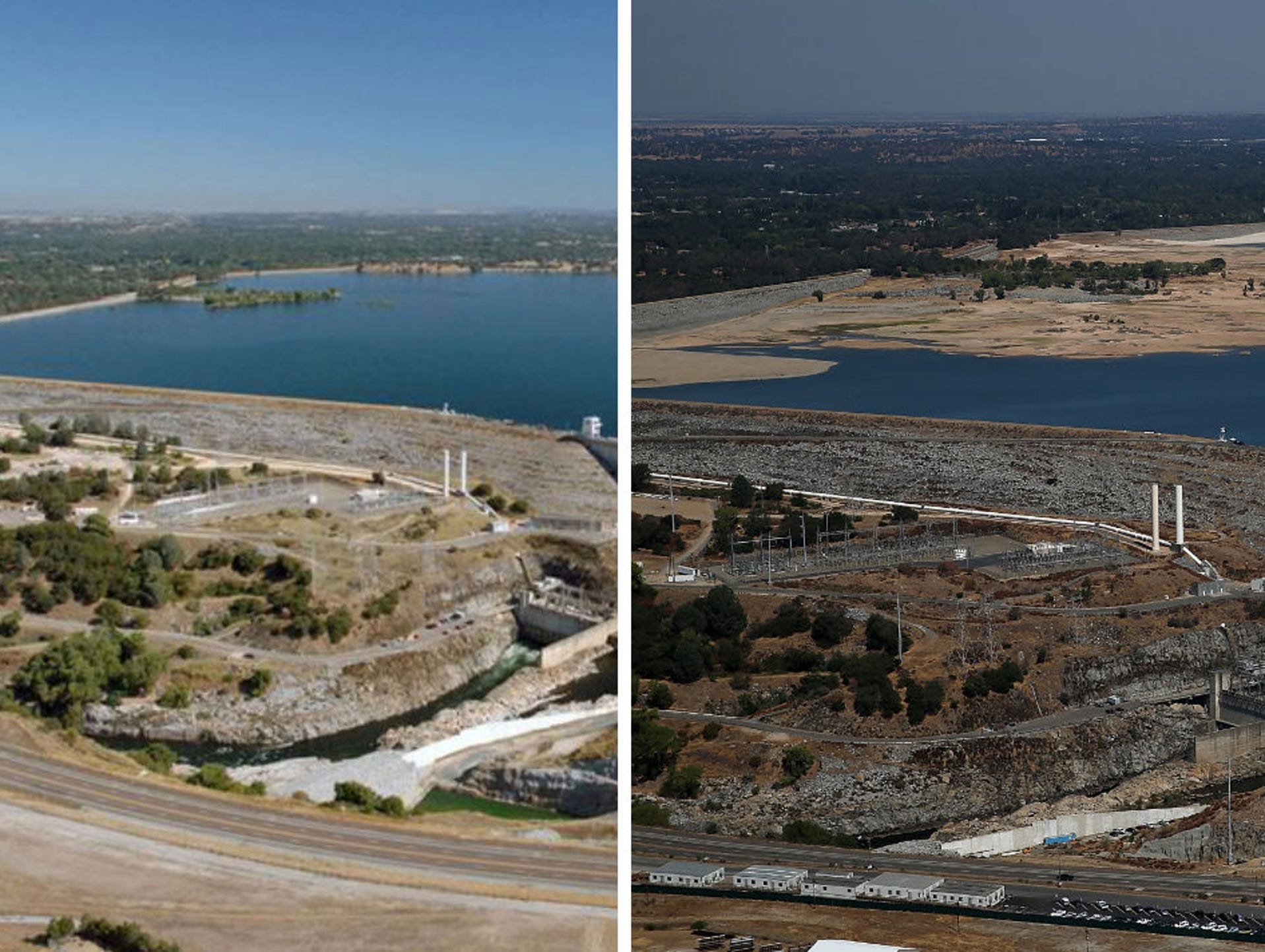 |
| Folsom Lake, California before and after |
Our governor declared a statewide drought emergency and we constantly are told to limit our water use to help conserve. The problem though is that no one (that I know of) is cracking down on the whole state like places like Las Vegas have done. But how could that even be done with such a big and opinionated state like California. Its not just a city with a water problem, its one of the biggest states in the country. If we don't get enough rain this year, it is scary to think of where we could be. The projections are frightening. This is my home that is more dry every time I visit. Actually experiencing the drought is so much different than just reading about it. It was hard for me to even grasp the severity of the whole situation until I saw one of lakes in person. My home is right smack in the middle of the "exceptional drought" area.
 |
| Current California drought monitor; Most of the state is now in exceptional drought |
I was skeptical when I learned that this class would be about water, but it has actually been a very interesting topic considering our huge need for water and our dwindling resources. The first few chapters of the Big Thirst were fascinating because I previously didn't really consider ALL of the things that require clean water in our everyday life. The amount of water that we use on things like flushing toilets and watering lawns is astonishing. The talking of a "second modern water revolution" is a crazy thing to think about.
What I found very interesting while preparing for our presentation on the Big Thirst is the idea that all water problems are local. Conserving water in Texas is not going to help children in Africa get water, or even really help California. So even though the drought is slowly becoming nationwide, the solutions are local changes in individual communities and cities. If anything, reading the Big Thirst has made me, and hopefully others, acknowledge the current water crisis in a more realistic way.
Monday, September 22, 2014
Traveling the Trinity
That Thursday marked the ending of one of the most stressful and emotional weeks of the semester so far. Right before the trip began I received hurtful news that did not put me in a good state of mind for a trip that I had previously been very excited for. I was running on too little sleep and too many emotions to appreciate the beginning of the 4.5 mile canoe trek. However, being stuck in a canoe with your best friend for a few hours can be surprisingly therapeutic to the soul. It was something that I never expected, but the canoe trip surprisingly helped to calm my mind and gave me time to relax for the first time in too long. At first I had been upset that the trip started off so rough for me, but then I became very thankful that it had coincided with certain life events. Floating along the Trinity River gave me time to appreciate the "little things" in life, as cliche as that sounds. The whole week I had been a ball of stress, worrying about both big and little things, and the canoeing allowed me to forget about it all for just a few hours. Together Casey and I figured out how to steer that canoe (it took awhile!) and that helped to distract me from the list of emotional things running through my mind. We laughed (at ourselves), complained (about too much to list), and ultimately made it down the river like a modern day Huck and Jim.

Halfway down the river I was already feeling better, yet none of my problems had been solved. They were still waiting for me back on land, but for those few hours all life issues were out of reach as we canoed in our own little world. I am a very logical and pragmatic person, someone who never would have thought that canoeing down a brown river would help me feel better after a long week, but it did. The journey calmed my previous anxiety and I believe helped me handle a stressful situation that was waiting for me back ashore. The serenity of the calm waters and the recurring motions of paddling was more therapeutic than I ever could have imagined. The entire setting was so tranquil and peaceful that even my racing mind could be calmed down for a few hours.
 Paddling up to that Fort Worth skyline at the end of the trip was a beautiful ending to a surprisingly valuable trip that ended up being exactly what I needed. The bright lights represented the real world where my problems sat
waiting for me to deal with, but the canoe and river aided me in
approaching them more wisely and calmly. Sure, when I got back to campus I still had to deal with my stressful problems, but the river trip had helped me to accept what had happened and had calmed my mind so that the problems seemed just a little bit more manageable.
Paddling up to that Fort Worth skyline at the end of the trip was a beautiful ending to a surprisingly valuable trip that ended up being exactly what I needed. The bright lights represented the real world where my problems sat
waiting for me to deal with, but the canoe and river aided me in
approaching them more wisely and calmly. Sure, when I got back to campus I still had to deal with my stressful problems, but the river trip had helped me to accept what had happened and had calmed my mind so that the problems seemed just a little bit more manageable.

Wednesday, August 27, 2014
How do you define literature and civilization?
Kyle Howarth - biology pre-med student at UC Davis
"Literature is a form or body of writing that serves a purpose (to entertain, inform, etc.). Literature is words with meaning."
"Civilization is a group that comes together and agrees on laws and regulations and has a government that holds them to a standard."
Caroline Brown - child development student at TCU
"Literature is the use of writing to tell a story or convey a certain ideal, and is often passed down through history."
"Civilization is the history of how cultures are made up and how peoples groups interact within those people groups."
Barbara Howarth - retired accountant
"Literature records social structure, current thoughts, and a certain point of time for history in a written form that everyone can understand."
"Civilization is a moral and social structure that creates a forward progressing peaceful existence."
"Literature is a form or body of writing that serves a purpose (to entertain, inform, etc.). Literature is words with meaning."
"Civilization is a group that comes together and agrees on laws and regulations and has a government that holds them to a standard."
Caroline Brown - child development student at TCU
"Literature is the use of writing to tell a story or convey a certain ideal, and is often passed down through history."
"Civilization is the history of how cultures are made up and how peoples groups interact within those people groups."
Barbara Howarth - retired accountant
"Literature records social structure, current thoughts, and a certain point of time for history in a written form that everyone can understand."
"Civilization is a moral and social structure that creates a forward progressing peaceful existence."
Subscribe to:
Posts (Atom)